

Presentation Transcripts
Latest Update : May 25, 2016
Back to Financial Results (FY3/2016)
Investor Meeting Presentation for FY 3/2016 held on May 10, 2016
- Cover
- Table of contents
- Financial Results
- Summary of Consolidated Business Results
- Summary of Consolidated Business Results for 4Q
- Net Sales
- Operating Income
- Machined Components Business (Yearly)
- Machined Components Business (Quarterly)
- Electronic Devices & Components Business (Yearly)
- Electronic Devices & Components Business (Quarterly)
- Net Income
- S.G. & A. Expenses
- Inventories
- Capital Expenditure & Depreciation
- Net Interest-Bearing Debt/Free Cash Flow
- Forecast for Fiscal Year Ending March 31, 2017
- Forecast for Business Segment
- Policy and Strategy
- Forward-looking Statements
 Download
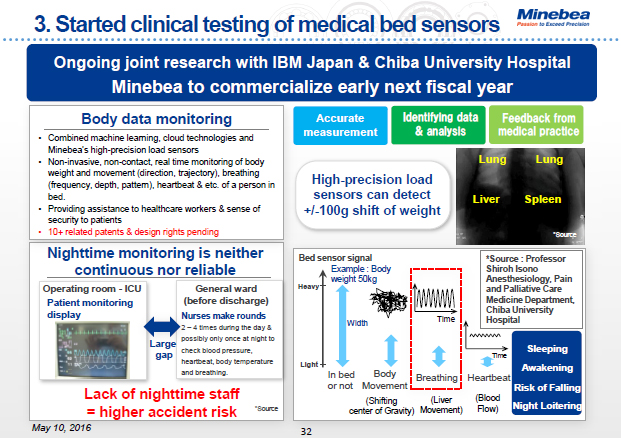

For me, the third initiative is the most exciting. Take a close look at the picture on the slide and you will see the liver, spleen, and lungs moving on the screen. The lungs keep working while we sleep because we keep breathing. More importantly, you will notice that liver, which is the biggest organ in a human body, also continues to move while you sleep. Our high-precision load sensor technologies have made it possible to monitor body data regarding body movement, such as the number of times people roll over in bed, their breathing, and their heartbeats, as well as whether a person is in bed or not. We believe that our sensor technology probably helps to monitor body data by detecting the activity of organs. This is often referred to as academic analogy. Chiba University Hospital has already launched clinical testing of the body data monitoring system. Similar clinical testing will also be carried out at other medical institutions. With the ability to monitor body data, our sensor technology could eventually become an integral part of a biological monitoring system, making it possible for doctors and healthcare workers to take care of many patients with limited staff. Nighttime monitoring (lower left), for instance, is a case in point. According to Professor Shiroh Isono at Chiba University Hospital, the risk of death for patients is greater when they are brought out of ICU, rather than while they are in it. The reason for that is patients are monitored very closely by the medical staff 24 hours a day while they are in the ICU, but the level of attention tends to get lower when they are out of ICU. The body data monitoring system used in the ICUs typically costs several million yen. I expect that our low-cost and precision sensing technologies will make inroads into the market.
 Previous
33page (total 36pages)
 You need Adobe Reader® to view these documents. Click on Adobe Reader icon on the left to download the software from the Adobe Systems website.
It ends about main text.