





Relationships with Customers
Latest Update : Apr.13, 2026
Basic Approach
In accordance with the Corporate Philosophy and the 'Five Principles' of our basic management policy, our company Group has established a quality policy to ensure the highest standards for all products we develop, manufacture, and sell. By earning the trust of customers worldwide and utilizing limited resources with maximum efficiency, we strive to be INTEGRATED precision component manufacturer that contributes to the development of global society.
To achieve this, we have established and implemented a quality management system. We continuously monitor its effectiveness and remain dedicated to ongoing improvements.
Corporate Philosophy(会社情報に移動します。)
Quality Management Framework
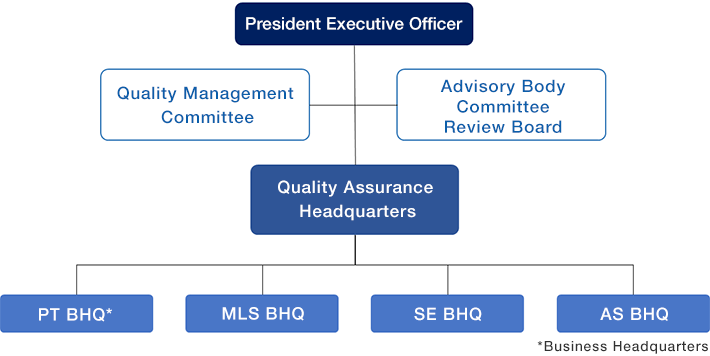
Our company group has established the Quality Assurance Headquarters directly reporting to the President Executive Officer, who has ultimate responsibility for quality assurance. Quality Assurance Headquarters engage works to improve quality across the entire group, under the guidance of the Quality Management Committee which serves as an advisory body in the quality field. The Company has also established Group Quality Management Rules and the Quality Assurance Managers Council, the Product Safety Council, and the Green Procurement Council. These groups are composed of managers representing each business unit and are responsible for maintaining a quality management framework that encompasses everything from development through to after-sales services, seeking to provide products that offer greater safety and security. This involves regularly addressing issues related to quality, product safety, and the production environment, sharing best practices and preventing problem recurrence, and gathering information from public institutions and external organizations.
Our Approach to Quality and Main Initiatives
❶Built-in Quality from Development Stage (=Front-Loading)
To prevent quality defects and avoid inconveniencing our customers, we allocate optimal resources from the product planning and design stages. We are committed to proactive prevention by building quality into our products from the earliest possible phase.
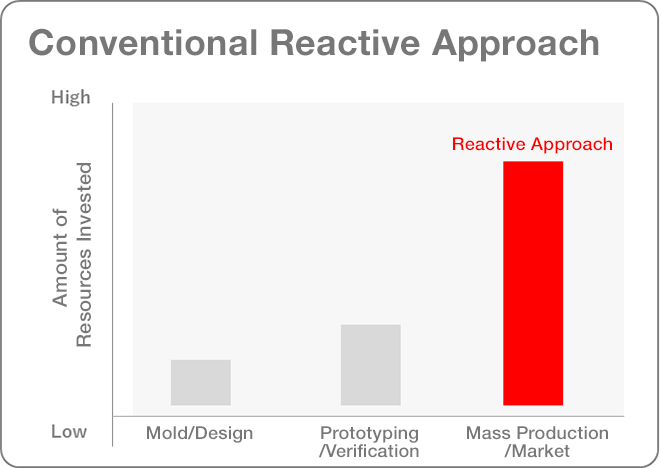
In the past, insufficient resources allocated during the product planning and design stages led to quality defects. As a result, significant resources were consumed by reactive measures, such as design changes and rework, after production had already begun.
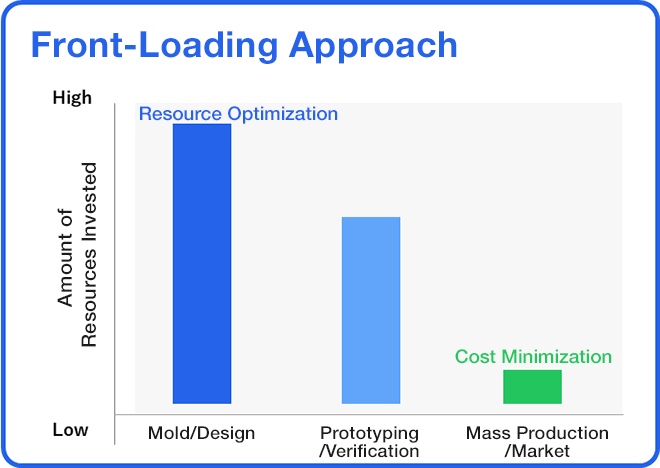
We optimize our resource allocation during the product planning and design stages. By building quality into our products through early-stage prevention, we minimize downstream issues, thereby reducing rework, disposal waste, and energy consumption. This approach enables us to achieve sustainable, high-quality manufacturing.
❷Recurrence Prevention
In case of a quality defect that may significantly impact our customers, we take immediate action to minimize any potential damages.
Furthermore, we conduct a thorough analysis of the root cause. Going beyond the immediate technical factors, we investigate underlying systemic issues to identify the true root cause and implement permanent corrective actions to prevent any recurrence.
When recurrence prevention measures require adjustments at the development source (product planning and design stages), we ensure rigorous feedback is provided. This feedback is integrated into our proactive prevention activities for future product development.
Recurrence Prevention Initiatives
- Minimizing Customer Impact through Rapid and Appropriate Initial Response
- Implementation of Interim Containment Actions
We immediately suspend shipments to inspect, identify, and segregate any potentially defective products, preventing further spread of the issue. Simultaneously, to support the continuity of our customers' operations, we implement enhanced outgoing inspections to guarantee quality for all urgent shipments, thereby minimizing any negative impact on the customer.
- Implementation of Interim Containment Actions
- Investigation of the Incident and Implementation of Corrective Actions
- Fact-Finding:
We take action based on the "Three Gen" principle—actual place (Genba), actual parts (Genbutsu), and actual facts (Genjitsu)—to gather the objective evidence necessary for identifying the cause. - Investigation of the Root Cause:
By comparing established standards with the actual facts, we identify the specific points of failure that led to the occurrence and outflow of the defect. We clarify the mechanisms behind why the defect occurred and why it was not detected. - Corrective Actions and Lateral Expansion:
We implement appropriate corrective actions targeting the identified mechanisms to prevent recurrence. Furthermore, we investigate the potential for similar issues at other manufacturing sites and production lines, performing "lateral expansion" (Yokoten) of these countermeasures as necessary.
- Fact-Finding:
- Root Cause Analysis and Recurrence Prevention
Upon completion of the immediate corrective actions, we go beyond just addressing the symptoms. We conduct a 'Why' analysis to identify and rectify underlying systemic and organizational flaws. Furthermore, these systemic improvements and corrective measures are laterally expanded to other manufacturing sites and production lines as necessary.- "Why" Analysis:
We conduct a comprehensive review of the sequence of events that led to the occurrence and outflow of the defect. After establishing a clear and objective factual basis, we perform a fact-based '5 Whys' analysis to uncover systemic flaws and identify the true root cause. - Recurrence Prevention Measures (1):
We implement systemic improvements to ensure that similar defects are never repeated in the next generation of products. (Preventing recurrence of the specific incident). - Recurrence Prevention Measures (2):
Based on the true root cause identified through the '5 Whys' analysis, we clarify systemic challenges and implement corrective measures to improve our organizational framework and processes. (Systemic Recurrence Prevention)
- "Why" Analysis:
Verification of Recurrence Prevention Implementation
Based on the principle that systemic recurrence prevention should not be left solely to the department in charge, the Quality Assurance Headquarters maintains an objective perspective. It verifies the content of the improvement measures, monitors their implementation and operational status, and ensures that these changes are fully internalized and sustained over the long term.Horizontal Deployment (Yokoten)
Corrective and recurrence prevention measures are not limited to the department where the issue originated. From the perspective of identifying potential risks across the organization, these measures are horizontally deployed (Yokoten) to other manufacturing sites and production lines. This proactive approach ensures the continuous elevation of quality assurance standards throughout the entire company.
MinebeaMitsumi Quality Policy-Based Initiatives
Product Safety and Environmental Initiatives
Compliance and Risk Management
We have established a robust framework to provide our customers with safe and reliable products, ensuring continuous compliance with international regulations regarding product safety and environmental protection. Furthermore, we pursue "Zero-Risk" manufacturing by conducting thorough risk assessments to anticipate and prevent potential issues before they occur.
Coexistence and Mutual Prosperity with Suppliers
Enhancing Value and Shared Growth across the Entire Supply Chain
Providing safe and reliable products to our customers is only possible through the strong bonds of trust we share with our suppliers, who provide us with essential materials and components. When necessary, we actively support our suppliers in establishing their own quality management systems.
Quality Management System Standard Certification
We have established a management framework that complies with the requirements of international quality standards, led by ISO 9001. Building upon this foundation, our systems are also tailored to meet the specific certification requirements of the various industry sectors in which we operate.
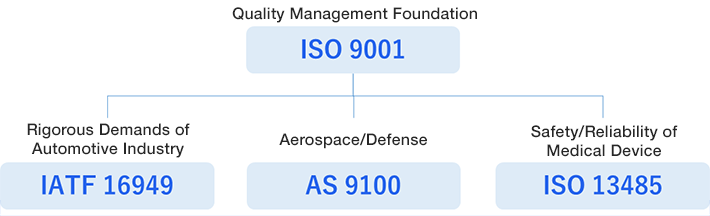
Global Quality Education
Global Rollout of Quality Education in Local Languages
To meet the trust of our customers, we place the highest priority on quality education.
In addition to fundamental quality control principles and specific management techniques, we educate our employees on the vital importance of quality compliance to maintain a culture of integrity in manufacturing.
Furthermore, we conduct quality education across our global manufacturing sites using local languages. By providing a learning environment where employees can gain a deep understanding in their native tongues, we promote consistent comprehension and elevate quality awareness throughout our entire global network.
Back Number